⭐⭐⭐⭐⭐
One of the auteur figures of Belgian cinema, Chantal Akerman’s second feature film, Jeanne Dielman, 23 Quai du Commerce, 1080 Bruxelles, has become one of her most internationally acclaimed works and, over time, one of the masterpieces of feminist cinema.
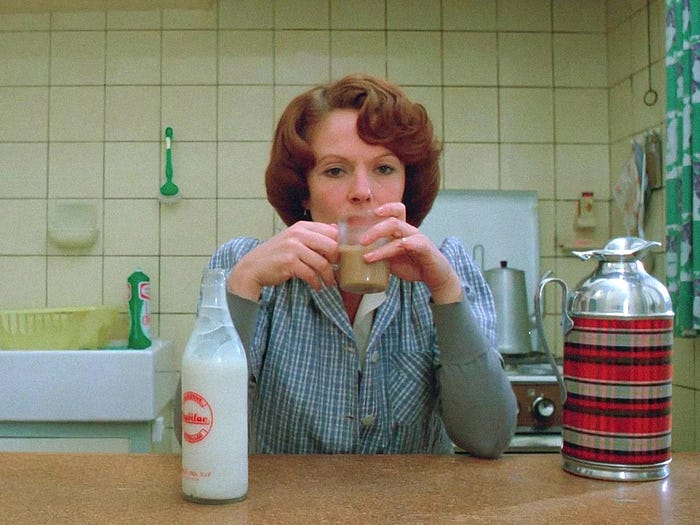
The film, which could be described as “the diary of a housewife,” follows a sparse structure with few actors and minimal dialogue, focusing on several days in Jeanne’s life. Over the course of 201 minutes, the camera — placed within specific spaces of the house such as the kitchen, living room, and bathroom — captures the daily routine of a housewife. The fragments of this routine consist of repetitions within a vicious cycle that constantly returns to the same point: cooking, cleaning, shopping, and so on. Hours, minutes, and seconds pass in a way that allows the audience to breathe in the ordinariness of domestic life. Akerman presents Jeanne’s daily tasks through a minimalist style, using static camera angles and long takes that avoid conventional cutting, portraying her domestic “actions” in their most ordinary form.
At first glance, this routine life may appear “boring” to the viewer. After all, there is nothing conventionally attractive about the life of the housewife depicted in the film. One could say that the director demands patience from the audience with her extremely long takes. Due to its attempt to capture the slowness of the moment, many viewers may label the film as a “boring art film.” Yet Akerman’s concern seems to be precisely to find a cinematic equivalent to the opposite of “speed.” In this sense, the film’s “lack of tempo” transforms into a rare and radical formal exploration.
For those who can immerse themselves in it, the suffocating, “caged” life of Jeanne — who lives with her son — is enriched with subtle details. With an observational perspective, Akerman introduces small disruptions into the character’s monotonous and colorless hours, such as Jeanne’s occasional engagement in prostitution. This act creates a slight “stirring” in her otherwise stagnant life.
However, her retreat into a room during the day to engage in prostitution functions much like cooking or cleaning — another task positioned within the same ordinary flow. Although Jeanne temporarily assumes the role of a sex worker, she remains a mother and a housewife. This role becomes intertwined with her other identities.
As Akerman’s camera dissects what is considered “normal,” she injects movement into the film with a striking gesture in the final act. While the monotonous details of daily life, the ordinary rhythm of existence, the sameness of the kitchen and the living room, and the domestic states of a woman are laid bare, the final “gesture” delivers a powerful conclusion.
That scene is a murder. Perhaps Jeanne responds to her numbness through this act, or perhaps she reaches a heightened awareness. The pieces of the film’s circular routine complete themselves from within. A woman’s place within social life, the oppressive nature of social codes and norms, the “dead” moments of modern life — all come vividly to life within the stark design of an apartment that seems devoid of pleasure. Thus, a few days in the life of a character who would seemingly hold no cinematic appeal become, in the hands of a talented director, a whole whose every frame we watch with anticipation. Of course, the contribution of Babette Mangolte’s cinematography and Delphine Seyrig’s performance to this feminist masterpiece cannot be overlooked.
Yorumlar
Yorum Gönder